
Creating Dynamic Dialogue through Atmosphere—Echoing Conversation
Echoing doesn’t mean redundancy. It means reframing. It means listening for the lines your characters carry like scars, prayers, promises.

Some words don’t fade—they circle back, wearing new meaning like weathered skin…

✨What’s a line someone once said to you that stayed with you over time? Why did it echo? How has its meaning shifted since you first heard it?
Atmosphere
Echoes in dialogue aren’t just repetition—they’re evolution. When a character repeats a line, it’s rarely the same. The setting may have shifted. The stakes may have risen. The speaker may have changed. And in that shift, the echo becomes a mirror—reflecting growth, regret, longing, revelation.
Atmosphere plays a vital role. A line whispered in a quiet kitchen may feel tender; the same line shouted in a storm may feel desperate. Echoing dialogue lets the environment reshape meaning, turning familiar words into emotional catalysts.
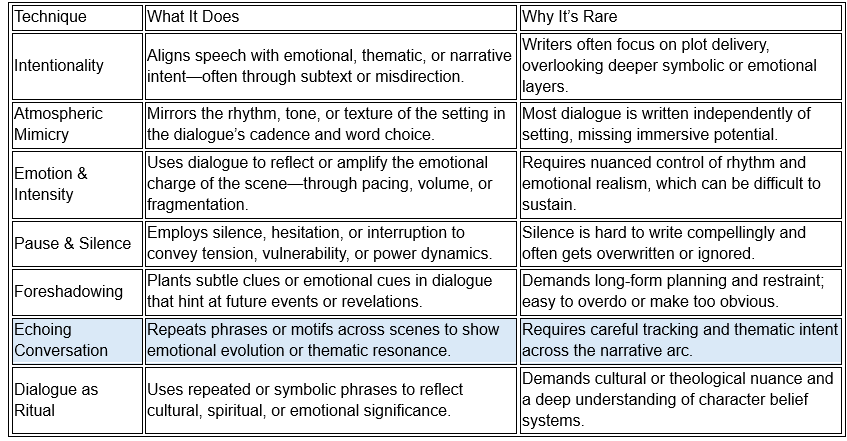
Part Six—When Words Return Changed, and Silence Remembers.
Some conversations don’t end—they echo. A phrase repeated days later, a question that resurfaces in a different tone, a line that circles back with new meaning. This is the art of Echoing Conversation—dialogue that reverberates through a story’s emotional landscape, shaped by atmosphere, memory, and transformation.
Some of the most memorable lines in fiction aren’t the sharpest or most shocking—they’re the ones that come back. A phrase uttered in the third paragraph that reappears in a different voice at the end of the story. A private joke that turns solemn. A throwaway comment that lands like prophecy on the reread. This is the craft of echoing conversation—a dialogue technique that stitches memory, meaning, and emotional depth into your story’s spine.
Finding places where repetition can become resonance. Where dialogue reflects a character’s arc, a relational shift, or a thematic undercurrent—not just once, but through thoughtful return.
Echoing doesn’t mean redundancy. It means reframing. It means listening for the lines your characters carry like scars, prayers, promises.
Let’s explore how to use echoing conversation to deepen character arcs, build tension, and create emotional resonance. You’ll learn how to plant phrases that return with weight, how to let setting alter tone, and how to craft dialogue that lingers—like a memory half-heard in the wind.
Let your characters speak in echoes. Let the story remember.
✨Choose a line one character says early in the story. Let another character repeat or respond to it later—but with new meaning. Try shifting the emotional temperature (tender → tense, joking → tragic) or revealing a theme that’s come full circle.
Pitfalls
Echoing conversation—when done well—can be haunting, poetic, or devastating. But when it misfires, it risks flattening the emotional arc or drawing too much attention to itself. Here are the key pitfalls authors often stumble into when using this technique:
Repetition Without Transformation
The trap: Repeating a line of dialogue exactly, without emotional or narrative shift. Why it falters: It doesn’t reveal anything new. It feels redundant instead of resonant. The reader wonders, Why are we hearing this again?
Forcing a Catchphrase
The trap: Trying to make a line “iconic” by repeating it too often or too obviously. Why it falters: It feels artificial, like the author is nudging the reader: Remember this line! It’s important!
Breaking Character Voice for the Echo
The trap: Forcing a repeated line into a character’s mouth when it doesn’t fit their voice or emotional state. Why it falters: It feels like the author is speaking, not the character.
Overusing Echoing to the Point of Redundancy
The trap: Repeating a line so often it loses meaning or feels gimmicky. Why it falters: Overuse flattens emotional impact and makes the repetition predictable or tiresome.
Pointers
Ask: What do you want the reader to feel after the dialogue ends? What emotional “echo” should linger?
Repeat with Transformation, Not Redundancy
Ensure the repeated line evolves. It should feel different depending on the context. Let the echo evolve. A repeated line should carry new weight, irony, or emotional reversal.
First use: “You’ll be fine. I promise.”
Later echo: “You’ll be fine,” he said again—but this time, he couldn’t meet her eyes.
Let Echoes Arise Naturally, Not as Forced Catchphrases
Echoing should feel organic, not like the author is hammering a point. Let it flow naturally. Instead of an exact word-for-word repeat, a variation can work.
First use: “Some bridges can’t be burned.”
Later echo: “…Guess some bridges really do stay standing.”
Echo Within the Character’s Voice and Emotional State
Let the echo arise from the character’s natural speech patterns, habits, or emotional triggers. If a character is sarcastic, their echo might be ironic. If they’re guarded, it might slip out under pressure.
Change the Speaker or Tone
A phrase can be echoed by a different character or in a shifted tone, altering its meaning.
First use: A parent tells their child, “You’ll understand when you’re older.”
Later, the grown child sighs and says the same line to someone else, realizing how much they’ve changed.
Echo becomes inheritance—phrases become “passed down” in a family or relationship. Using it again implies that certain truths or patterns are cyclical, even when characters don’t realize they’re repeating them.
Use It as a Turning Point
Echoed dialogue can signal a shift in character growth, realization, or resolution. If an arrogant character dismisses something early on—“That doesn’t matter.”—but later whispers it in regret, the repetition highlights their transformation.
It works best when the first use of the line is tied to a strong emotional beat, so the callback feels loaded with meaning rather than coincidental. This repetition often pairs with a choice, action, or revelation that cements the arc’s resolution—whether that’s acceptance, defeat, forgiveness, or growth.
🌿Write a new scene with a powerful emotional line (grief, blame, promise). Then go back and write the earlier scene where the line originated. Let the second scene retroactively color the first.
Punctuation!
Now for last week’s question: How do you properly format dialogue when a character is quoting someone else?
🖊️ When a character quotes someone else, use single quotation marks inside double quotation marks to differentiate the quote within the dialogue.
“She always said, ‘Follow your instincts,’ but honestly, I have no idea what that even means anymore.”
“He looked at me and said, ‘You’re not the same person you were.’”
Notice how the single quotes nest neatly inside the double quotes, even when they sit side by side at the end of the sentence.
If the quoted dialogue spans multiple paragraphs, use opening quotation marks in each paragraph but only close at the end of the speech.
The Journey Continues…
🖊️ How do you punctuation a dialogue volley of snappy back and forth banter?
Next week, we’ll answer this question and finish our series exploring atmosphere with dialogue as ritual.
Until then, may your pages hum with purpose and clarity.
What returns isn’t the line, but who you’ve become since you first heard it.